
Travel Tips
Beijing, China
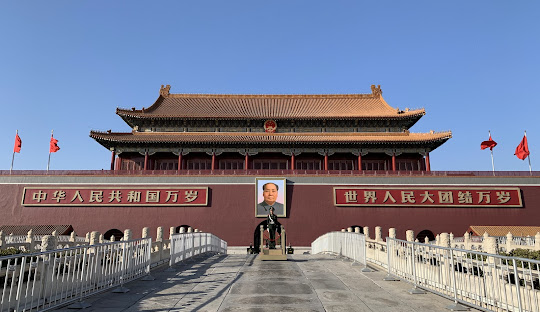 Beijing
previously romanized as Peking, is the capital city of
China. With more than 22 million residents, it is the
world's most populous national capital city, as well as
China's second-largest city by urban area, after Shanghai.
It is located in Northern China, and is governed as a
provincial-level direct-administered municipality with 16
municipal districts. Beijing is mostly surrounded by Hebei
Province and neighbors Tianjin Municipality to the
southeast; together, the three divisions form the
Jing-Jin-Ji cluster.
Beijing
previously romanized as Peking, is the capital city of
China. With more than 22 million residents, it is the
world's most populous national capital city, as well as
China's second-largest city by urban area, after Shanghai.
It is located in Northern China, and is governed as a
provincial-level direct-administered municipality with 16
municipal districts. Beijing is mostly surrounded by Hebei
Province and neighbors Tianjin Municipality to the
southeast; together, the three divisions form the
Jing-Jin-Ji cluster.
Beijing is a global city and one of the world's leading
centers for culture, diplomacy, politics, finance, business
and economics, education, research, language, tourism,
media, sports, science and technology, transportation, and
art. It is home to the headquarters of most of China's
largest state-owned companies and houses the largest number
of Fortune Global 500 companies in the world, as well as the
world's four biggest financial institutions by total assets.
It is also a major hub for the national highway, expressway,
railway, and high-speed rail networks. For a decade before
the COVID-19 pandemic, Beijing Capital International Airport
was Asia's busiest airport (2009–2019) and the
second-busiest airport in the world (2010–2019). In 2020,
the Beijing subway was the fourth-busiest and second-longest
in the world. Beijing Daxing International Airport,
Beijing's second international airport, is the largest
single-structure airport terminal in the world. The city has
hosted numerous international and national sporting events,
the most notable being the 2008 Summer Olympics and 2008
Summer Paralympics Games. In 2022, Beijing became the first
city ever to host both the Summer and Winter Olympics, and
also the Summer and Winter Paralympics.
1. Great Wall
1. Sanlitun Fashion Shopping District
Airport
The Great Wall was continuously built from
the 3rd century BC to the 17th century AD on
the northern borders as a great military
defence project of Chinese dynasties.
2. Palace Museum
Carrying 5,000 years' Chinese history and
culture, the magnificent architectural
complex is thus recognized as one of the
most prestigious cultural heritages in China
and the world. In 1987, the Palace Museum
was listed as a UNESCO World Heritage site.
3. Peking Man Site at Zhoukoudian
Established in 1953, Zhoukoudian Site Museum
serves as an ancient human site museum and
has been recognized as a UNESCO World
Cultural Heritage Site and a national
4A-level scenic area.
4. Summer Palace
The history of the Summer Palace can be
traced back to 1750 during the reign of
Emperor Qianlong of the Qing Dynasty.
5. Temple of Heaven
The Temple of Heaven was listed as a UNESCO
World Heritage site in 1998. Situated in
southern urban Beijing, it was visited by
emperors of the Ming and Qing dynasties for
annual ceremonies of worship and prayer to
Heaven for good harvest.
6. Ming Tombs
Established in 1409, these tombs have a
history spanning over 300 to 600 years and
across 40 square kilometers. The site is not
only the largest imperial tomb complex in
China, but in the entire world, housing the
most tombs of emperors and empresses.
7. Grand Canal
The Grand Canal was inscribed on the UNESCO
World Heritage List in June 2014.
Constructed from 486 BC, it consists of
three major parts, i.e. the Sui-Tang Canal,
the Beijing-Hangzhou Canal and the Zhedong
Canal, which comprise 10 sections.
8. Central Axis
The Central Axis runs for 7.8 kilometers,
from the Drum and Bell Towers in the north
to Yongdingmen in the south, passing Wanning
Bridge, Jingshan Park, and the Palace
Museum.
Main commercial facilities: Taikoo Li,
Sanlitun SOHO.
Introduction: Beijing's Sanlitun, a place
that's constantly evolving, has many
nicknames including the "holy land of
fashion", a "meeting place for hipsters" and
the "center of fashion and culture". As
such, the trends and fashion of Sanlitun are
inseparable. With its multitude of stylish
areas, fashionable streets, and commercial
centers, Sanlitun draws and entertains
people in droves for leisure.
2. CBD International Shopping District
Main commercial facilities: Beijing SKP,
China World Mall.
Introduction: Based on Beijing SKP, China
World Mall, and other shopping malls,
Chaoyang District has established its CBD
International Shopping District, leading
international consumption trends, creating
an internationally influential fashion
landmark and building an "international
reception hall" that signifies
multi-cultural integration and development.
3. Qianmen, Dashilanr Commercial District
Main commercial facilities: Beijing Fun,
Qianmen Street.
Introduction: This commercial district,
south of Tian'anmen Square, and west of
Qianmen Street, running 275 meters
east-west, is located in what was the center
of old Beijing, forming an important part of
the city's southern axis. Shopping, dining,
entertainment, and other facilities line the
block, making Qianmen Street one of the
must-see destinations for experiencing
Beijing culture. In the past, many famous
theaters, teahouses, bookstores and even the
first cinema in Beijing were once seated in
this area.
4. Wangfujing Commercial District
Main commercial facilities: Beijing apm
Shopping Mall, Wangfujing Department Store,
WF Central.
Introduction: Wangfujing Street is a famous
pedestrian street in Beijing, running a
total of 810 meters north-south, with over
700 stores of varied sizes scattered along
both sides. Many famous time-honored brands
can be found on this commercial street with
a history of over 700 years. Wangfujing
Department Store, WF Central, along with
many others that have over 100 years of
retailing history, mostly purvey daily
necessities and dining, to domestic and
foreign visitors.
Beijing has two major airports: PEK and PKX.
PEK is the world's busiest airport, while
PKX is the largest single-structure airport.
Both offer a range of services and
transportation options. Contact details
provided for more information.
Online Car-Hailing
Online car-hailing apps in China, like DIDI,
T3 Chuxing, and CAOCAO Chuxing, offer
convenient and safe transportation options.
Using DiDi as an example, learn how to hail
a ride with easy steps and payment methods.
Bus
Beijing's extensive bus network offers 1,500
routes, operating from 5:00 to 23:00 with 36
overnight routes. Use BEIJING PASS, Bus QR
code on Alipay, or cash with small notes for
fares. Follow safety guidelines and stay
alert on stops. Tel: 86-10-96166.
Subway
Beijing's rail transit network has 27 lines
covering 836km with 490 stations. Ticket
fares vary based on distance. Convenient
ways to purchase tickets include Beijing
Pass, Alipay QR code, ticket vending
machines, and manned counters. Major tourist
attractions are easily accessible via subway
lines. For more information, contact
86-10-96165.
Taxi
Summary: By 2023, our city has 206 cruise
taxi companies with 60,000 vehicles. Pricing
includes a base rate of 13 RMB for 3 km,
with additional fees for low speed, booking,
night, co-ride, and fuel surcharge. Hail a
taxi by hand signal, book in advance, or use
car-hailing apps like Didi. Payment options
include cash, Wechat, Alipay, and Unionpay.
Remember not to hail at intersections, and
most drivers may not speak English.
Railway Station
Beijing Chaoyang Railway Station, located in
Dongfeng Township, Beijing, serves
high-speed and ordinary trains. It features
functional stratification, service
facilities, and multiple entry/exit points.
Contact: 86-10-51825923.